Showing posts with label Asuncion's Water Privatization Conflict. Show all posts

Saturday, May 10, 2008

The Pros and Cons of Privatization

Now some people argue that the privatization of water is a necessary evil. It may not be positive for the people of Paraguay in the short, financial term, but in the long run-it's effective and will help stave off disease and poverty.

Privatization Pros:

- While most countries are committed to increasing access to safe water and thereby reducing child mortality
- Water will reach more people in a more efficient manner

Privatization Cons:


* As a basic human need, water service should be a responsibility of governments. Transfer of control to a private entity that seeks to maximize profits reduces public accountability and can adversely affect the quality and equity of service.


* Water privatization can negatively impact low-income and underserved communities by unfair rate increases and poor service to these communities.


* Water privatization may lead to lower quality service and higher rates. In cases where communities have tried to reclaim their water systems from private entities, poor water quality, unresponsiveness to customer complaints, and rate hikes have been the most frequent complaints.


* Private multinational companies don't have a stake in the community in which they operate. This can have negative effects on small communities when it results in firing city employees and hiring new staff or significantly cutting benefits to long-time employees.


* Many privatization agreements fail to include adequate public participation. In addition, many of these contracts do not include enough provisions for contract monitoring and accountability.


* Many privatization efforts ignore the impact on local ecosystems and downstream water users, and may have long-term negative effects on the environment.


* Private companies, which stand to make more money for the sale of more water, may neglect the potential for water use efficiency and conservation improvements.

For more information.

Let's look at the victims here: the PEOPLE and the ENVIRONMENT! Both voices are lost in the grand conflict that is raging around the privatization of water.

Now, according to Parlimentary reports much of the aid that grassroots campaigners against the privatization of water has been given by the Parliament. This is hardly surprising when considering that Paraguay has a fairly new democracy (still with a few kinks of course) as its governmental institution. Representatives from all over the country spoke for their people and voted 32 to 7 against the privatization of water in 1994. It was a victory, and assured the Paraguayan people that their political system did speak for them, even in the face of not reaching IMF targets. Privatization by ESSAP was again shelved, but barely, in 2004-an indicator of the battle that Paraguay is losing ground on with every successive year.

Paraguayans have had their fair share of unfair treatments. Recall the era of tyranny of three successive dictators, the reliance on the World Bank and IMF for aid, and of course: being a third world country and dealing with poverty, disease and lack of development. The government, while attempting to be representative is plagued with corruption, and the once self-sufficient agricultural sector is moving toward mass production of products like soybeans and corn, which will not sustain the population. This is just another hurdle that the country must overcome in the pursuit of some sort of stability.

The people in Paraguay have never really had to PAY for such a fundamental thing as water, and if all of a sudden, they are made to spend a portion of what little they have on water-it takes away from things like education and the exact types of opportunities that would pull Paraguay towards modernization.

Look at this conflict: It's not quite a true zero-sum conflict, (where whatever is gained by one side is lost by the other) because both the corporations and people get something. It is unjust and unfair in many ways because the people of Asuncion are losing money, but getting safe water-but this money goes directly into the corporations. It's like paying for water and basic sanitation: the rich people have to pay, and they can, while the poor people have to pay and oftentimes can't.

In the interest of "preventing death" by charging for water that will decrease disease and infant mortality, what about the people in Asuncion that can't afford the high prices of water and end up dying of thirst? Where's the social justice in that?

Think about it...

-L

Sunday, April 20, 2008

The Real Story

Now, with all the historical turmoil that Paraguay has undergone a few more human rights violations don't seem like such a big deal. However, let's not take this situation lightly, for the privatization of water in the country's capital is not just a passing phase. This conflict has been a hot debate for years, and it's not settling down any time soon.


Let's start from the beginning...

What is privatization?


Well-- simply put: A basic definition for privatization in the water or sanitation sector involves transferring some or all of the assets or operations of public water systems into private hands.This does not necessarily mean the privatization of water resources themselves occurs because water services are seen as such a key public service. Proposals for privatization of them often evoke stronger opposition than for other sectors. Globally, over two-thirds of modern water and sanitation systems are publicly owned and operated.

For more information on the different types of Privatization Models: Click Here!

Apply this to water... this taking water and charging the public for how much they use. Water! The public will be charged for the water they drink, bathe in, wash their clothes in and use in cooking...


Here's the Story:


In Asuncion, Paraguay, the Public-Private Infrastructure Advisory Facility (PPIAF) had been working toward steering Paraguay towards water privatization even though there was popular resistance against it for ten years running.

In 1995, the World Bank began a sewerage project in Asuncion which would theoretically give more citizens would have access to sanitation. They sought to introduce private sector participation in water supply and sanitation. The World Bank has since reported that this project failed, but again, in 1999 they tried to convert it into "a vehicle for privatizing the water and telephone companies".

(The Paraguayan government changed its mind on whether to refocus the project solely on privatization and eventually the project failed to go ahead.)

This failure to proceed with privatization was one of the reasons that the World Bank reduced its funding in Paraguay between 1999 and 2004.

"Participation of private capital in public infrastructure, as evidenced by, for example, further expansion of water/sanitation services via existing minimum subsidy concession schemes with private operators; taking to point of transaction two PPPs in infrastructure investment."
-World Bank. (2004). Country Assistance Strategy for the Republic of Paraguay 2004/07. World Bank. Washington DC.

In December 2000, PPIAF paid $75,000 (US Dollars) with an additional $15,000 from the World Bank, to fund a consultant to develop options for a concession contract for the primary Paraguayan water utility Corposana.

The project also sought to build a consensus on the sector reforms with all the stakeholders, the government, Corposana, the private water providers, and consumer and business groups.

This consensus was supposed to be obtained through a 'participatory approach', but was at odds with PPIAF's assertion that the required outcome was the yielding of Corposana's urban water services to one or more private operators.

Corposana's name subsequently changed to Essap.

In June 2002, the concession plans were voted against by the Paraguayan senate, because local unions stood up against water privatization. It became an issue in the 2003 elections, when some candidates and parties were for the privatization and some parties were against it.

After promising not to sell any more state-owned companies, Nicanor Duarte won the presidential election and promptly announced there were no plans to award a private concession contract for Essap. Instead a plan was launched to reform the utility from within the public sector.

In February 2004, Jose Alderete, Public Works and Communications Minister, said that the government would be seeking World Bank investment to assist them with reforms in the water sector. BUT the World Bank was clear that privatization would be REQUIRED in order to receive any aid whatsoever.

"Some of the additional or deeper policy areas where the Bank has advised the administration to turn its attention ... include ... promotion of public-private partnerships for infrastructure development and maintenance through concession contracts for operation and construction, performance-based maintenance contracts and minimum subsidy concessions for expansion of water and sewerage."
-World Bank. (2004). Country Assistance Strategy for the Republic of Paraguay 2004/07. World Bank. Washington DC.

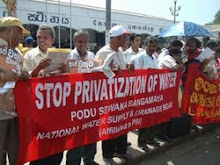
Over the summer of 2004, those in favor of privatization tried to revamp the policy that was voted down in 2002. Unsurprisingly, 5000 people protested through Asuncion against the law, and it was voted down again.

In September 2005, Business News Americas reported that in discussions over a new back-up plan with the International Monetary Fund, IMF: the Paraguayan government had to draw up plans to introduce private sector investment to four state-owned companies, including Essap.

Finance Minister Ernst Bergen was quoted as saying, "We are totally open to private sector participation, with the view that administration is passed to the private sector; so that the private sector has an interest in being involved in these companies."


Wait... what?


Two months later, PPIAF approved a new activity to assist the Paraguayan government in developing a new water strategy to enable the participation of local private sector operators in the country. Consultants paid with $175,000, with an additional $114,200 from other sources, would analyze options to restructure the utilities, and PPIAF funded activity also included building a stake-holder consensus for individual utilities.

In May 2006, a management contract for Essap, along with four other companies was proposed, and supposed to be active by December 2006.

Despite public protest, popular elections, and parliamentary votes, the IMF is still pushing water privatization in Paraguay, a process begun and re-launched by PPIAF.

Now, parliamentary members and civil society organizations, SOBREVIVENCIA (Survival) amongst them, are pressing for the final approval of a new law on water.


This will guarantee access to water as a human right, and declare all water a property of the state.What exactly is the deal here? Consider the violation of rights in this situation.

Democracy is being trampled... and now, Asuncion has some of the highest prices for water in South America.


Drink it in...
-L